Barnabas
Isaiah 42:5-12; Acts 11:19-30; Matthew 10:7-16 ~ Chapel of the Apostles, Sewanee, TN

“See, the former things have come to pass, and new things I now declare.”
(Isaiah 42:9)
From the depths of exile, among a people who had lost their homeland, their pride, perhaps in fear of losing their very identity, the Spirit again came alongside the prophet Isaiah and his broken people to tell them they were not forgotten; that what Babylon meant for evil, God was even now bending toward good; that God’s faithfulness to his fallen bride, his tenderness toward her in the very rubble of her ruin, would show her yet to be “a covenant to the people, a light to the nations, to open the eyes that are blind and bring the prisoners out of the dark.”(Is. 42:6-7) That same Spirit who hovered over the first waters, who walks alongside Israel and alongside the nations who sit in darkness and alongside the whole groaning creation, was speaking: “See, the former things have come to pass, and new things I now declare.” (42:9)
Today, we remember one of the servants of that Spirit, who like his ancestors, lived in the shadow of empire, among a nascent movement of disciples of One who proclaimed the fulfilment of those ancient promises and blew the doors wide open to the scope and scale of that prophetic vision.
He enters the story without fanfare in Acts 4:36, first introduced to us as Joseph, a Levite from Cyprus. But the Apostles gave him a new name: Barnabas, which we’re told means, “son of encouragement.” The Greek phrase here is huios Paraklēseōs, drawn from the same root as Paraklētos [Paraclete]; the name Jesus uses for the Holy Spirit in John’s Gospel: the Advocate, the one who comes alongside. Barnabas doesn’t just encourage with words. He does what the Spirit does. He walks alongside. He lifts up. He strengthens in solidarity.
When news reached Jerusalem that even Gentiles in Antioch were turning to Jesus, the community sent Barnabas to investigate. And what was his reaction when he got there? The text says, “When he saw the grace of God, he rejoiced.” (Acts 11:23) No suspicion. No tests. No need to control the situation. Only joy. He came alongside these new believers, encouraged them, taught them, and stayed as long as he was needed.
But this wasn’t a one-off event for Barnabas; it was the pattern of his character. When the newly converted Paul was met with fear and distrust in Jerusalem, it was Barnabas who came alongside him and vouched for him to the Apostles (Acts 9). When Paul later rejected John Mark for abandoning a mission, it was Barnabas who gave John Mark a second chance (Acts 15). Again and again, Barnabas stood beside those on the margins of belonging and made room for them.
His ministry reflects what Jesus commands in today’s Gospel: “You received without payment; give without payment.” (Mt. 10:8) Like the disciples, Barnabas traveled light. No money, no spare tunic, only peace to offer and grace to share. His was not a strategy for maintaining boundaries, drawing lines between insiders and outsiders, or for institutional preservation. His was a way of life, a vision of ministry, rooted in inter-dependence, humility, mutual generosity, and discovery.
We’ve all come to this Mountain: some to study, some to teach, some to work, some to rest. But we all come to this Table as guests, to learn from the Spirit of Jesus and to be fed with his very being. Here we remember, whether as laypeople, deacons, priests, or bishops, that our deepest calling is to come alongside. To walk in love with one another through joy and struggle. To discern where the grace of God is already at work. And then to rejoice. To bless. To give as freely as we have received as we await the Dawn where God’s Spirit will “open the eyes that are blind and bring the prisoners out of the dark.”(Is. 42:7)
For indeed, “the old has passed away, behold the new has come.” (2 Cor. 5:17)
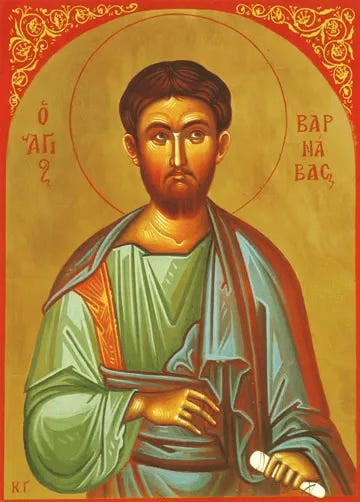
Image: Icon of St. Barnabas. Written by the monks of St. Paul’s Monastery, Marietta, WI.
Two of our friends joined us at a Greek Restaurant where we celebrated Barnabas. It was a red letter day on the calendar. We had to.