But the Lord saw...
Genesis 29:15-28 [29-35]

And in the morning, behold, it was Leah.
The sun is not quite up yet. And Jacob wakes in the gray light and turns to the woman he has worked seven years to marry, seven years that passed like a few days because he loved her that much, and the light comes up slowly across the tent. But when he turns it’s not Rachel beside him. It is her sister, Leah. Every one of us hears this as a catastrophe, because Scripture has handed us Jacob’s eyes to see it with, and through Jacob’s eyes the arrival of this wrong woman is the worst thing that could have happened. Let’s put his perspective over to the side for a moment. We’ll come back to it before we’re done.
You’ll remember that Jacob is the younger of twin brothers who wanted the older brother’s first-born birthright and took advantage to essentially steal it from him. You’ll remember that he also deceived their blind father Isaac in the dark, wearing his brother’s clothes to smell like Esau and with goatskin strapped on his arms to feel like him to trick the old man into blessing Jacob instead of Esau. Last week, we left him on the run for his life, in the middle of a field at Bethel with a stone for a pillow, where God met and blessed him, the wrong man, before he had repented of a single thing. But just because Jacob received God’s grace and promise does not mean that his choices didn’t have consequences.
In Laban, his future father-in-law, Jacob meets his match. The man who took the firstborn’s blessing by deceiving a blind man in the dark has himself now been deceived in the dark. Jacob fell in love with Laban’s daughter Rachel, and agreed to work for Laban for seven years before she would be given him in marriage. And on the wedding night Laban brings her older sister Leah instead, veiled, in the dark, and Jacob does not know until the sun rose. The deceiver is deceived, and if the story ended there it would be a tidy thing about what goes around coming around.
But it does not end there, and the one who pays is not Jacob. Yes, Jacob works another seven years and gets Rachel too and he walks away with both sisters and his wages besides. The one who pays is Leah, who deceived no one. She is carried into that tent and handed over in the dark and discovered in the morning as a disappointment, and then she is bound for life to a man who does not choose her and does not want her, and across all the years the story gives them, he will not ever love her. Her whole life is settled in a bargain between two men in a room where she has no voice, and when the sun comes up she is the woman nobody wanted to marry.
Our lectionary, again, cuts off the end of the chapter, in effect centering Jacob and Rachel and doing to Leah what is always done to her. But this morning, let us see Leah. Continuing our reading in Genesis:
So Jacob went in to Rachel also, and he loved Rachel more than Leah. ... When the LORD saw that Leah was unloved, he opened her womb, but Rachel was barren. Leah conceived and bore a son, and she named him Reuben, for she said, “Because the LORD has looked on my affliction, surely now my husband will love me.” She conceived again and bore a son and said, “Because the LORD has heard that I am hated, he has given me this son also,” and she named him Simeon. Again she conceived and bore a son and said, “Now this time my husband will be joined to me, because I have borne him three sons”; therefore he was named Levi. She conceived again and bore a son and said, “This time I will praise the LORD,” therefore she named him Judah. [29:29-35]
She was not just unloved, she is the hated wife, and God sees her heartbreak, and that seeing turns out to be the underlying hinge of the whole story.
Listen to how she names her children. The first son comes and she calls him Reuben, which means “see”, as in see a son! Surely my husband will love me now. The next year, she bears another son, and she names him Simeon, which means “hear”, as in the LORD has heard that I am hated, and yes still she waits for Jacob to turn toward her. The next year a third son, Levi, which means “joined”, as in surely this time my husband will finally be joined to me. Three sons, three namings, three times she reaches across that cold tent for a man who seems to only be interested in the progeny she might bear. And three times the tent stays cold. It is one of the most human stretches in all of Scripture, this woman doing everything her world allowed a woman to do to earn a love that was simply never coming.
And then her fourth and final son came, and something brakes open. She calls him Judah, which means “I will praise”, saying, “this time I will praise the LORD.” The longing for her husband is gone. She has stopped asking Jacob to be what he will not be. She is not joined to Jacob; she is joined to God.
And this is where perspective shows us the long view of God. Out of her son Judah’s lineage will come David, the shepherd boy nobody bothered to call in from the field when Samuel came looking for a king, because the LORD does not see as mortals see; we look on the outward appearance, but the LORD looks on the heart. And from David’s lineage, in the fullness of time, comes Jesus. When Matthew sits down to write the genealogy of the Messiah, he does not run the line through Rachel, the wife Jacob wanted, the wife he worked fourteen years to win. He runs it through Leah, the unloved wife nobody chose. The promise God gave to Jacob and the covenant God made with Abraham runs straight through this woman most of us have forgotten.
And that is what I want you to see this morning. Leah stays a minor character to the end; she gets no chapter of her own, no scene where Jacob finally sees her and weeps and repents. She never gets to be loved as she longed to be. But the promise of God runs through her anyway, quietly, while every eye in the story is fixed on someone else.
What God gives her is not a rescue. What God gives her is presence in the middle of a brokenness that is never fully healed. She is not chosen, but she is not abandoned either; she is not loved by her own husband, but she is also not forgotten by God; she is not the focus of the story, but she is the bearer of the promise.
This is the good news this morning for everyone who has done everything right and still not been chosen, everyone who has poured out their heart and soul and got nothing in return, everyone who has held a family or a marriage or a church together with no acknowledgment, thanks, or applause. The world runs on an economy that defines who is worthy by their appearance or wealth or influence, handing its blessings to the beautiful Rachels, while exploiting the Leahs. But God sees by another light. God saw Leah when Jacob would not, and the whole promise of God came down through the one nobody wanted to marry.
In a few minutes, we will all be invited to this Table. Some of us come this morning feeling sure of our place in this community, grateful for the body we belong to. Some of us come knowing Leah’s ache, the pain of being unloved or rejected or forgotten. Most of us carry a little of both. So come! When the love you long for does not arrive, when your hopes fall apart, and the world around you is collapsing, here is where we turn and find the One who has seen you and held you all along. Here, shoulder to shoulder, the fullness of grace is placed into every outreached hand. Come and turn, with her, toward the One who has never once counted worth the way we count it. And then go and do likewise; learn from Leah to see with open eyes, to recognize those left behind and discarded, whether in another’s face or the one in the mirror.
This time we will praise the LORD.
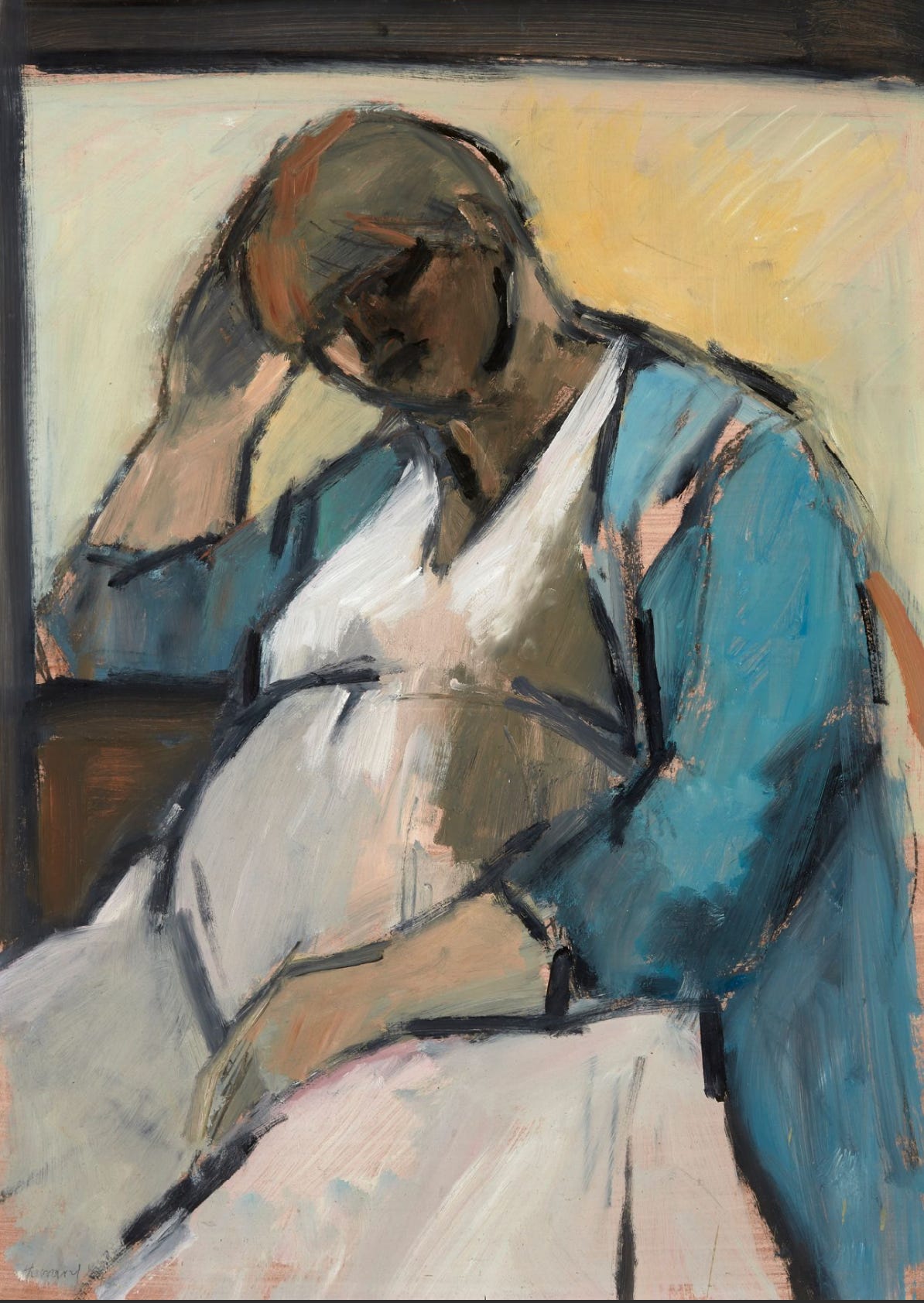
Image: “Pregnant Self Portrait” by Ghislaine Howard. Oil on board. 1984. https://ghislainehoward.com/