Come and See
John 1:29-42

Our gospel reading this morning focuses on two young disciples of John the Baptist, one was St. Andrew and other was likely St. John. They’ve spent months listening to John preach about repentance, about preparing the way for God’s deliverance, about the promised Messiah who is coming. And then John points to a figure walking in the distance and says something that will change their lives forever: “Behold, the Lamb of God who takes away the sin of the world.”
Without a question, the two disciples immediately leave John and start following this stranger. As they walk along, Jesus turns, looks at them, and asks the most searching question: “What are you looking for?” They respond with their own question; but notice what they ask. They don’t ask “What is your philosophy?” or “What kind of theology do you teach?” They don’t even ask “Are you really the Messiah?” They ask something much more intimate: “Rabbi, where are you staying?”
Where are you staying? It’s a question about location, yes, but it’s really asking something deeper. Where do you abide? What makes you real? What is your anchor and stability in this world? They don’t ask everyday, surface-level questions; they had indeed, after all, been attentive students of John the Baptist.
Jesus’ response is simple and profound. He invites them to “Come and see.”
But before we go on, let’s go back to John the Baptist’s declaration, because it holds the key to understanding what these disciples were about to discover. When John calls Jesus “the Lamb of God who takes away the sin of the world,” he’s not just giving Jesus a nice title. He’s announcing a complete reversal of how religion and power have always worked.
Throughout human history, across cultures, sacrificial systems emerged as a way to deal with violence and conflict within communities. Someone had to bear the weight of individual’s or the community’s guilt, someone had to be expelled or sacrificed so the rest could have peace. The pattern runs deep: find a scapegoat, place the blame, and the violence that threatened to tear us apart gets redirected on a single victim.
But John proclaims a great reversal of this sacrificial pattern. This is not our lamb being offered to appease an angry God. This is God’s Lamb, offered to appease us. God is not the one demanding violence and bloody sacrifice. We are. The true God comes not to inflict wrath but to absorb it, to endure our violence, to show us once and for all that God stands with the victim, and not with the crowd wielding stones.
At the beginning of our Gospel reading, John the Baptist had said, “I saw the Spirit descending from heaven like a dove, and it remained on him.” That word “remained” used here is the same word in the question asked by the two disciples: “stayed.” The Spirit of God remained, stayed, abided in Jesus. The Father remains, stays, abides in the Son. And now Jesus invites these first disciples into this same life of remaining, staying, abiding; to dwell in him as he dwells in the Father.
This is what anchors Jesus in the real. Not power or possessions or military might or territorial control, but this mutual indwelling with the God of love who holds all things together.
We in the 21st Century might think we’re far beyond those primitive, bloody sacrificial systems. We may not slaughter animals on altars to appease the angry gods anymore. But that pattern of thought still runs much deeper than we want to admit. We still look for scapegoats. We still believe that someone else’s suffering might purchase our own peace and security.
This week in Minneapolis, federal immigration enforcement escalated into violence. A woman was shot and killed. Tear gas in the streets. Children caught in the crossfire. The ancient pattern at work: designate a group as the source of our problems, and suddenly extraordinary measures against them seem justified, even necessary.
On the other side of the world, a ceasefire that was supposed to bring peace has not stopped producing casualties. Children are dying in the cold, families still losing loved ones. And the violence is dismissed as necessary and justified. The same old story: we must eliminate the threat to finally have peace.
Throughout history, empires have always claimed the right to expand, to dominate, to secure their interests through force when necessary. The language changes (manifest destiny, sphere of influence, national security) but the pattern remains. Power seeks more power, and finds reasons why this particular expansion, this particular use of force, this particular war is different from all the others.
So, the question those first disciples asked must become the question we grapple with today: Where do we remain, stay, abide? What is grounding and anchoring us?
Do we abide in the certainty that our nation’s violence is somehow more righteous than others’? Do we rely on the fear that unless we control, dominate, or expel, we’ll lose what we have? Are we anchored by tribal loyalties that require us to defend our side’s actions while condemning those same atrocities committed by others?
These things cannot hold us. Empires fall. Security built on violence crumbles. Fear can only breed more fear. And when what we’ve been abiding in fails, then we discover just how desperately we need solid ground.
Which brings us back to Jesus’ invitation. After Andrew and John spent that afternoon with Jesus, the first thing Andrew did was find his brother Simon. “We have found the Messiah,” he said.
When Jesus looked at Simon, he said, “You are Simon son of John. You are to be called Cephas,” which means Peter, the rock. Jesus sees him, names him, gives him an identity grounded not in what he achieves or accumulates or conquers, but simply in being known, called, and given.
This is the invitation that remains for us: “Come and see.” Come and discover what it means to abide in the One who refused to wield power violently, who absorbed our violence rather than return it, who stands with victims rather than with the powerful. Come and find your home not in what your tribe controls, not in who you can exclude, not in what enemies you can defeat, but in the love that will never ever let you go.
Come and see that God is not the wrathful judge demanding sacrifices, but is the loving parent who offers belonging, family, and eternal home. Come and see that we don’t have to construct our worth by dominating others or make ourselves safe by hording more and more for ourselves. The Lamb of God offers to take away that sin, that ancient, deadly pattern that we keep falling back into.
The question Jesus asked those first disciples, he asks us today: What are you looking for? What do you seek? Security through strength? Peace through dominance? Righteousness through exclusion?
Or are you looking for a place to belong that doesn’t require making others not belong? A life that’s real because it’s grounded in love rather than fear?
Behold the Lamb of God continues to invite you: “Come and see.”
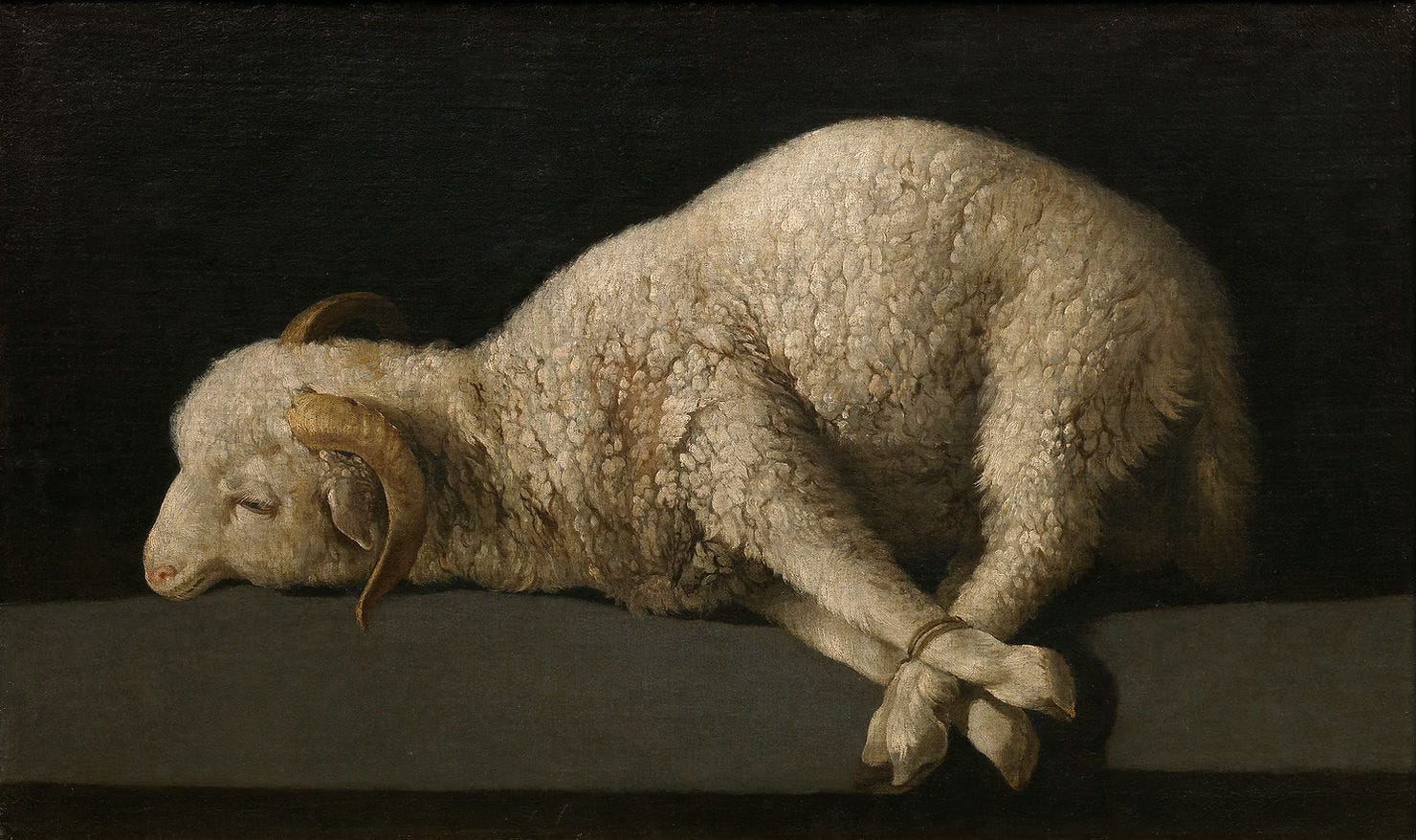
Image: “Agnus Dei” by Francisco de Zurbarán. c. 1640. Oil on Canvas. Located in Museo del Prado, Madrid.