Ever Deeper In
A Pentecost Sermon – Acts 2:1-21; John 7:37-39

Let anyone who is thirsty come to me, and let the one who believes in me drink. As the scripture has said, ‘Out of the believer’s heart shall flow rivers of living water.’ – John 7:38
Last week, we remembered the Ascension of Christ as the necessary prelude for the arrival of God the Holy Spirit. But in ascending “to the right hand of the Father,” Jesus does not leave his physical body behind. He brings it with him, and in doing so elevates the created, material, human world into the very heart of God and onto the living throne of heaven. As Malcolm Guite describes in his poem Ascension:
We saw him go and yet we were not parted
He took us with him to the heart of things
The heart that broke for all the broken-hearted1
This is what Colossians means when it speaks of the ascended Christ: “Christ is all, and is in all.”2 The fullness of God now permeates all of creation through the embodied, risen, and now ascended Christ.
If the Ascension is God’s inhale of the brokenness of creation, then Pentecost is God’s exhale of healing upon it.
The sudden blast of his breath sounded from heaven like the howling of a fierce wind. Flames of fire alighted on each one of them gathered in that place, set ablaze yet not consumed. They were all filled with the Holy Spirit, which flows from the side of the glorified Christ. But recall that the King of Glory was glorified not upon the throne of heaven, but rather in being nailed to and lifted up on the Cross. The Holy Spirit flows from the glorious wound of Christ, the breath of that ascended Body now exhaled back into the world he has taken into himself.
Because Pentecost was a major Jewish festival, there were devout Jewish pilgrims from every nation under heaven arriving in Jerusalem, and when they heard the sound of the wind, they gathered and were astonished, because everyone heard the disciples speaking of the resurrected Christ in their own native language.
Luke’s list of the peoples represented there is striking: Parthians, Medes, Elamites, residents of Mesopotamia, Judea, Cappadocia, Pontus, Asia, Phrygia, Pamphylia, Egypt, Libya, Rome, Crete, Arabia. What might be missed from our distant 21st Century perspective is that some of the nations named no longer existed even in the now ancient first century; specifically, Parthians, Medes, and Elamites… all far more ancient peoples associated with the Tower of Babel early in the Book of Genesis. Luke mentions them on purpose to conjure in our minds that ancient story and demonstrate how the arrival of the Holy Spirit is the fulfillment of the Prophet Joel:
I will pour out my spirit on all flesh;
your sons and your daughters shall prophesy,
your old men shall dream dreams.3
You remember that story of the Tower of Babel. The kings of Babylon tried to build a tower into heaven, that they might take upon themselves the splendor of divine power. So, God confused their speech, not to stop humanity from acquiring divinity, but rather to expose what exploitation had already destroyed: the powerful elite had broken communion with the poor and lowly they used and exploited to build their tower, and when that relationship, that communion, breaks down, so does communication. The confusion of tongues simply made visible what was already true. And the construction project ground to a halt. The confusion of language in the story serves as a great equalizer, a dismantling of the mechanisms of empire.
But on the Day of Pentecost, that confusion reverses. It does not reverse by giving everyone one common language. Rather, Pentecost reverses Babel by making genuine comprehension, recognition, and understanding possible across difference. A few are not elevated to be like God, rather God lowered himself to become one of us.Then having taken the very stuff with which we are made into his very heart, then poured out his healing Spirit upon his broken creation! “I in them and you in me, that they may become completely one.”4 Divinity is a gift to be received, never taken.
This is what the Spirit does, because this is what Christ does.
Look at the whole shape of Jesus’ ministry. He moves toward the leper, toward the woman with the hemorrhage, toward the man no one would touch, toward the criminal dying beside him. Every step is further in, not further out. And the cross is not an interruption of that pattern. It is the pattern, carried to its furthest possible depth. The crucified and resurrected Christ ascended into everything, in order that his Spirit might move through us and call us toward everything, toward every person, toward every stranger, toward the one across the table whose convictions are not our own.
In the summer of 2018, I stood in a hearing room at the General Convention of the Episcopal Church in Austin, Texas, my husband beside me, waiting to give testimony on Marriage Equality. The room was full. People had come from across the church to speak, for and against, out of theology, out of history, out of deeply held conviction, out of their own lives.
I gave my testimony directly after Bishop Greg Brewer of the Diocese of Central Florida. We did not agree on this issue. He said so plainly, grounding his position in his own reading of Scripture. And yet he spoke in favor of Resolution B012, the compromise before the Convention, because he had concluded that marriage equality was not a central issue to the Gospel of Jesus Christ; but that unity, love, and forgiveness were. He was not willing to fracture the church over it.
While the hearing was still going on, I stepped outside. Bishop Brewer followed me out and asked if he could buy me a cup of coffee. We sat down together and spoke generously to one another. While we did not leave that table in agreement, somewhere in the conversation we recognized one another as brothers in Christ, and neither of us could say to the other, “I have no need of you.” The compromise resolution B012 passed a couple days later, and the church found a way to walk together. Today, I am proud to call Bishop Brewer a brother in Christ.
Friends, the Spirit of Jesus does not shield us from the noise and the rage and the painful divisions of this age. Christ, who has ascended into everything, into every last soul, now calls each of us toward each other by calling us to himself. The Church is born in that dynamic of communal calling, from the chaotic waters over which the Spirit hovered and brooded like a mother hen, until those waters became the fountain of baptismal life. Again, turning to Malcolm Guite, he writes:
For now the Lord will give you your desire
And set you high upon his holy hill.
He draws you to the garden through the fireBack to the fountain where those waters spill
That christened you as his belovèd child
That you may find your peace in his good will.5
The Spirit draws us there. Not up and out of this world, but back and in, through the fire, ever deeper and deeper into the mire of this world, not to be abandoned there, but to find the very source of those waters that named you beloved. To the place where you first heard your name spoken by the One who made you, who made us all. And from that place, from this very Table, sent out again. Back toward one another, for “Christ is all, and is in all,” and “out of the believer’s heart shall flow rivers of living water.”
Malcolm Guite, “Ascension,” in Sounding the Seasons: Seventy Sonnets for the Christian Year (Norwich: Canterbury Press, 2012).
Colossians 3:11
Joel 2:28
John 17:23
Malcolm Guite, “II Quare Fremuerunt Gentes,” in David’s Crown: Sounding the Psalms (Norwich: Canterbury Press, 2021), 2.
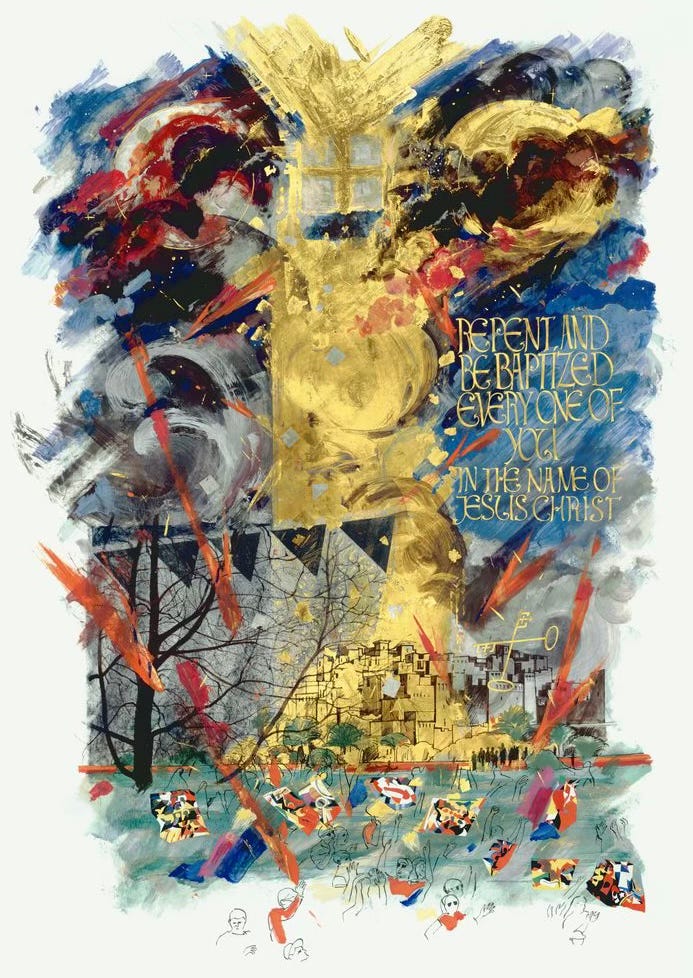
Image: “Pentecost” by Donald Jackson. Mixed media. 2002. The Saint John’s Bible, Saint John’s University, Collegeville, Minnesota USA. Used by permission. All rights reserved.