Do You Love Me?
Genesis 22:1-14

Genesis 22 is one of the most difficult and uncomfortable stories in Scripture. A father is commanded by God to take his son up a mountain and sacrifice him as a burnt offering. Abraham without a question is obedient, travels up the mountain, binds his son to an altar, and raises the knife. For many of us who grew up in church, we’ve been asked to understand this as Abraham’s great and unwavering example of faithfulness; the model we’re all called to imitate, willing to sacrifice everything for God. But, while Abraham may not have many questions about this, I certainly do! God asked you to do what exactly? And you had nothing to say about that? And Isaac just laid down willingly? What did Sarah have to say when you got home?!
To get a better understanding of what’s going on here, we have to go back much earlier in the story, back before Isaac was even born; back to where God’s covenant promise to Abraham was made.
In Genesis 15, God comes to Abraham in a vision. Abraham is already quite old; his wife Sarah is barren; they have no children together, no heir, no future. But God promises Abraham that his descendants will be as numerous as the stars in the heavens, that God would give him a land of his own, and that through his descendants, all the families of the earth would be blessed.
But this promise, this Covenant, was not just a contract in the modern sense; it was the seal of a relationship; like a blood-brothers’ pact, or adopting a child, or a marriage – God and Abraham were now bound together. So, this is most definitely a two-sided relationship! God, the Creator and Sustainer of the universe, chooses to become vulnerable, dependent on Abraham receiving it and to live in complete trust that God would be faithful in return. That vulnerable trust is the heart of covenant relationship.
But then Abraham fails. Not once, but over and over again.
First, he takes matters into his own hands. He knows he’s been promised by God to have innumerable offspring, but he’s getting old and his wife Sarah is barren. So, at his wife Sarah’s suggestion, has a child with his slave Hagar. After this, Abraham and Sarah found themselves in a dangerous situation; when a foreign king takes notice of Sarah’s beauty, so Abraham passes her off as his sister and gives her to this king to save his own skin. By the way, he did the same thing to her years before in Egypt, passing Sarah off as his sister to save his own skin… and he got rich off of it in the process too.
Again and again, when faced with fear, Abraham does not trust the God who has bound himself to him, and he chooses do things his own way to save his own skin rather than believe that God would fulfil his promise. And at what cost to others?!
But notice how God is the vulnerable one in this covenant relationship. Even after Abraham forgets God and goes his own way, God does not abandon the covenant relationship. Despite Abraham’s failures, God upholds his end of the bargain, to remain vulnerable and in relationship to this man who doesn’t seem to trust that God will actually follow through.
Years pass and, miraculously, 90-year-old Sarah finally gives birth to Isaac. God had proven himself to be faithful by giving him and Sarah a son in their old age. But God still doesn’t know if Abraham loves and trusts him. Which leads us to this ultimate test: God says to the now 100-year-old Abraham: “Take your son, your only son Isaac, whom you love, and go to the land of Moriah, and offer him there as a burnt offering.”
Frankly, I don’t think God knows what Abraham will do. Given Abraham’s history, given that Abraham has time and again chosen self-preservation over trust, God genuinely does not know if Abraham will choose differently this time. The outcome is not predetermined. God has bound himself to this covenant, and now God waits to see if Abraham will finally trust him with everything, even with the son on whom the promise of innumerable descendants is dependent.
I’d like to interject something for those of you who just can’t get over how God could ask anyone to sacrifice their child, and how Abraham seems so willing to obey: In the ancient world, child sacrifice was practiced in many of the cultures around ancient Israel, and indeed has been practiced around the world in a variety of cultures. While it would certainly have been distressing and agonizing to any parent, child-sacrifice in the ancient world would not have been completely unheard of. Indeed, our modern world has certainly not abandoned the practice of killing our children.
As we just read, God speaks to Abraham and commands him to do this horrible thing. So, Abraham packs his knife, gathers wood and his son, and they travel to Mt. Moriah. On the third day, he can see the place in the distance. He tells his servants who were traveling with them: “The boy and I will go up there and worship, and then we will come back to you.” But does Abraham really believe this? He is going there to kill his son.
They climb. Isaac, carrying the wood for his own sacrifice asks his father, “Father, I see the fire and the wood, but where is the lamb for the burnt offering?” And Abraham says, “God himself will provide the lamb.” But again, does Abraham really believe this? He knows he intends to kill his son.
They reach the place. Abraham builds an altar, he arranges the wood, then binds Isaac to the altar, and with tears flowing and hands shaking, raises the knife to kill him.
This is the moment! This is where Abraham’s faith is tested not as abstract obedience, but as willingness to surrender everything. And Abraham does it. He is about to kill his own child.
Just then God stops him. An angel of the Lord calls out to him: “Abraham! Abraham!” And Abraham answers, “Here I am.” And the angel says, “Do not lay your hand on the boy. Do not do anything to him. For now I know that you fear God, since you have not withheld your son, your only son, from me.”
The Christian tradition confirms this, but in an unexpected place. Traditionally, this story of the near-sacrifice of Isaac was read on Good Friday, making parallels to Christ’s sacrifice on the Cross. However, if the Cross was the binding of a new covenant, then I think our story about the testing of Abraham is better answered by the post-resurrection appearance of Jesus when the risen Lord asks Peter three times, “Do you love me?”1 You’ll recall the night Jesus was arrested and crucified, Peter denied him, failed him, three times before the cock crowed. But here, Jesus doesn’t ask Peter to apologize or even, “Will you obey me?” He asks, “Do you love me? Do you love me? Do you love me?”
This is what we see in both stories; a God deeply, faithfully committed to human beings, a relationship bound by trust and loving-kindness, vulnerable to whether we will love and trust him in return.
This is the God at the heart of our faith. Not God the all-present, the all-powerful, or the all-knowing One. But rather a God terribly, terrifyingly vulnerable in love. A God who has bound himself to us and waits, genuinely, to see if we will love and trust him in return.
Today we have been called to this altar where the God of Abraham, Isaac, and Jacob, the God and Father of our Lord Jesus Christ, gives and binds himself to us again, vulnerable, in bread placed in our hands and wine placed on our lips, who asks each of us: Will you receive this bread? Will you trust me in how you live your lives? Will you meet me in the faces of neighbors and strangers alike? Do you love me?
John 21:15-19
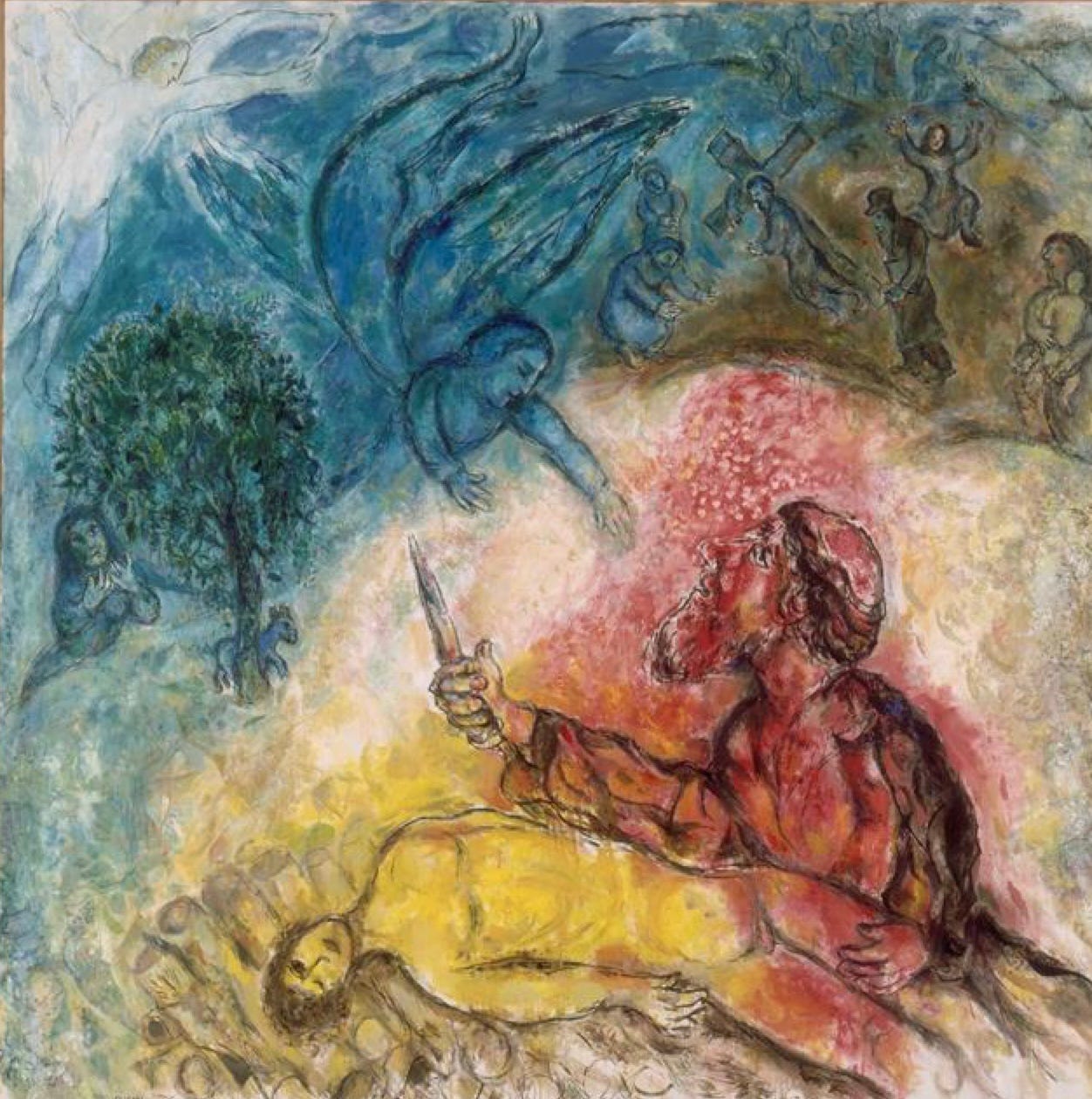
Image: “Le sacrifice d’Isaac” by Marc Chagall. 1966. Oil on canvas.
Musée National Marc Chagall, Nice, France.