Peniel
Genesis 32:22-31 (33:1-10)

We’ve all had those nights when we lie in bed in the dark, wide awake, unable to stop our minds from racing. Some worry, some conflict, some conversation we are dreading, someone we do not want to face... We lie there for hours, wrestling with our thoughts and our words, playing them out over and over.
That is where we find Jacob today.
Two Sundays ago, we were with him on the night he ran from home, facedown at Bethel with a stone for a pillow, a thief who had just stolen his brother Esau’s birthright and blessing. We were with him again in Laban’s tents, where the cost of his scheming fell on Leah. Now he is rich, with wives and children and flocks, and God commands him that he must return home. But home means the one thing he has spent twenty years trying not to think about. Home means Esau.
Esau, whose birthright he bought for a bowl of stew, whose blessing he stole off their old blind father, and who swore he would kill him. And now that Jacob is on the road home, word comes that Esau is already on his way to meet him, and he is bringing four hundred men.
So, Jacob does what Jacob always does. He schemes. He splits his company in two, so that if one is struck the other might escape. He sends droves of goats and camels on ahead as gifts, wave after wave, hoping to buy back with livestock the brother he robbed. He sends his wives and his children and everything he owns across the ford of the River Jabbok in the dark. And then Jacob was left alone.
Alone and in the dark. With his anticipation of tomorrow’s encounter. Whatever lies on the other side of the Jabbok, Jacob waits that night with nothing but himself.
And suddenly, without a word of explanation, a man appears, wrestling with Jacob all night, like a dream too real to be a dream. But who is he? Is it Esau, come alone in the dark? Is it Jacob’s own fear of his past come to collect in the dark? Is it God? Scripture does not say, and I think that is on purpose. All night the two of them strive and neither lets go. The schemer, for once, has nothing to bargain with, no way to weasel out or gain the upper hand. Like mirror images of one another, they strive, and when Jacob’s opponent sees he cannot prevail he strikes Jacob on the hip and throws it out of joint, but Jacob still holds on. “I will not let you go,” he says, “unless you bless me.”
Two Sundays ago the blessing was given freely to this man who had tried to steal it from his brother and father, who immediately began to bargain: if God will be with me, then the Lord shall be my God. But now, there is no if left in him. He has nothing to trade and no one to trick. The blessing he once received lying down, asleep, he now must hold on to with his whole strength, gripping his nameless opponent in the dark, and it is going to cost him.
There, wounded and clinging, he is given a new name. No longer Jacob, the trickster, the heel-grabber, the supplanter, but Israel, the one who strives with God and with humans and prevails. He does not win; he prevails, which is a different thing. He holds on until the day breaks.
And when the sun comes up, he’s alone again, and Jacob names the place Peniel, which means “the face of God,” saying “I have seen God face to face, and yet my life is preserved.” Two Sundays ago, God came down to him, at Bethel, and blessed him; but Jacob was asleep for it. This time he is awake. This time it is a struggle that will leave him with a limp.
But notice where Jacob is wounded. Jacob came into the world grasping his brother’s heel; he has spent his whole life quick on his feet, getting out ahead, running from Esau, outmaneuvering Laban, always in motion and always with an angle. Now he is struck in the socket of the hip, and suddenly the man who could always run away is made to limp. He will go out to meet his brother slowed and exposed, unable to flee if it goes wrong, with none of the advantage he has spent a lifetime securing. He will have to stand there and be seen.
And that’s where our reading stops. As it did with Jacob’s vow two weeks ago, as it did with Leah’s sons last week, the lectionary cuts off the most important part of the story.
Jacob crosses the river, looks up, and there is Esau coming with his four hundred men. So, he goes out ahead of everyone, hobbling from his injury, in eye-sight of his brother, and bows to the ground seven times, bracing for the blow he has feared for twenty years. And then this:
But Esau ran to meet him, and embraced him, and fell on his neck and kissed him, and they wept. (33:4)
No knife of vengeance in hand. No four hundred men charging to wipe him and his family out. Only a brother running across the open field, to fling his arms around his brother’s neck, the two of them weeping there, reunited. Jacob, who has spent his entire life scheming and fleeing, who has just spent the night grappling with God and his guilt and his fear, says to his brother Esau, “truly to see your face is like seeing the face of God.” (33:10)
Jacob arrives where he started, at the edge of the land he fled, in front of the brother he was born grasping. The same place. And he knows it now for the first time, because the brother he wrestled and feared and ran from, the twin who wears his own face, is the very face of God. The home he could never earn is handed back to him as grace.
Friends, in a few minutes I will stand in front of this Table and say, “The peace of the Lord be always with you,” and you will turn to the person beside you and offer them your hand. We do this every week as part of the liturgy itself; we do this purposefully then just before we offer our gifts along with bread and wine. For Jesus said, “when you are offering your gift at the altar, if you remember that your brother or sister has something against you, leave your gift there before the altar and go; first be reconciled to your brother or sister, and then come and offer your gift.” (Matthew 5:23-24) The Peace is not an intermission in the service; it is Peniel; it is the ford of the Jabbok; it is Esau running across the field to embrace his brother.
So, when you turn to your neighbor this morning, look at them. Really look. And then think past this room, and remember the one who is not here: the sibling who’s always been your rival, the friend you don’t speak to anymore, the family member who remains absent at family dinner. Think of the one who wronged you; and the one you wronged. Reach out your hand to the neighbor beside you and keep that person in mind, because it is practice for the harder reaching out still to come. The one you are most afraid to face is where God has been waiting for you all along, but to cross that distance with open hands is to arrive, at last, at home.
As T. S. Eliot wrote:
… the end of all our exploring
Will be to arrive where we started
And know the place for the first time.1
T. S. Eliot, “Little Gidding,” in Four Quartets (New York: Harcourt, Brace, 1943)
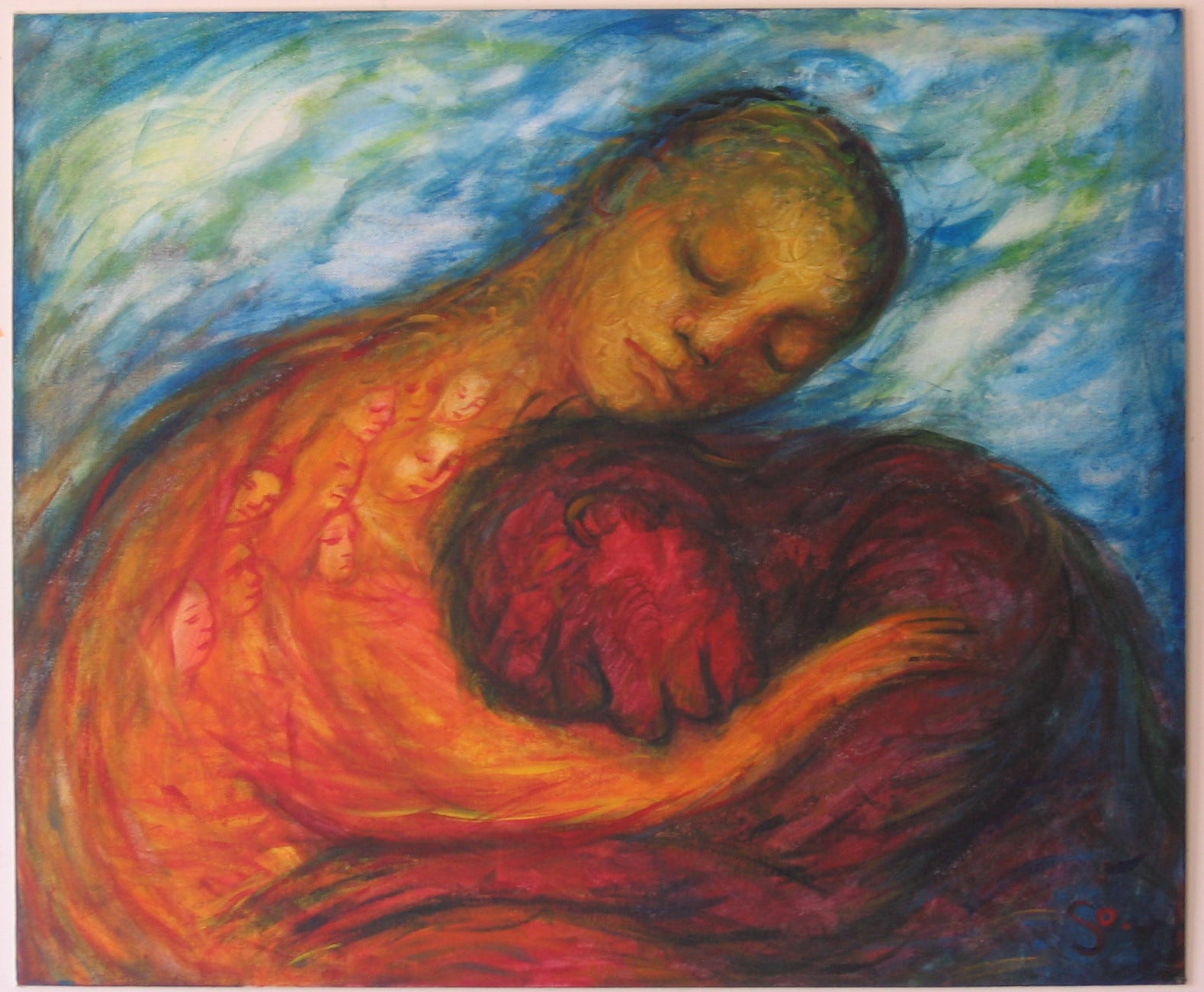
Image: “Forgiveness” by Sofiya Inger. Acrylic on canvas. 2013.
www.sofiyaingerart.com
Insightful. Thank you for this beautiful reflection. Jacob coming face to face with the person who has his face…..wow.