The Yoke
Romans 7:15-25, Matthew 11:16-19, 25-30

In my parents’ house there hangs a lamp that my grandfather made. It hangs from the ceiling in a side room that is filled floor to ceiling with décor from the Old American West. My grandfather was a bit of a Western junkie and when my grandparents died, well over a decade ago, much of his collection came to my parents. It’s a fun room in my parents’ house, filled with memories… literally, both old and new. But this lamp has held a place in my mind for quite some time. It’s a chandelier of sorts, made from a wooden double yoke, originally cut and shaped for a team of mules to plow a field. At some point my grandfather looked at it and saw something worth salvaging, so he ran a wire through it, fashioned a couple of lamp fixtures in it, hung it from the ceiling, and gave it a second life.
I wonder if he had not transformed that yoke what might have been its fate. Most likely it would have eventually been discarded in a move along the way, a relic of a way of life long forgotten by the modern world.
As I was contemplating the words of today’s Gospel lesson that coincided with this particular weekend as our nation celebrates two hundred and fifty years of independence, I found myself sitting with these words of Jesus: “Take my yoke upon you… For my yoke is easy, and my burden is light.” That image of a yoke conjured this memory of my grandfather’s yoke-lamp, and had me thinking, pondering, meditating about how we’ve come to the present day of our nation’s history. As we celebrate the declaration of our independence from Great Britain, I wonder if by cherishing our liberty as a fragile, precious treasure we have done a similar thing to those freedoms that my grandfather did with that yoke: An object of strength, a costly thing of real-everyday-practical value, a thing intended to do hard work, but something we have hung on the wall where it’s preserved, where it’s seen for its outward beauty, but no longer functions as it was intended… as a yoke. But a yoke on the wall means that somewhere there’s a field that goes unplowed.
In 1864, a hundred and sixty years ago, in the middle of a war over exactly this question having just signed the Emancipation Proclamation, President Abraham Lincoln told a Baltimore crowd that the world has never had a good definition of the word liberty; “We all declare for liberty,” he said, “but in using the same word we do not all mean the same thing.”1 Somewhere along the way, the idea of freedom in America became more about rugged individualism, about acquiring wealth by any means necessary, about becoming unfettered from the responsibilities to others, and “finding one’s self.” Freedom has come to mean that I don’t wear anyone’s yoke on my neck, nobody has claim on my time, nobody constrains my choices. But today, as the smoke clears from the fireworks displays and we clean up after our cookouts; and this morning, as we offer God thanks for the astounding blessings we all share in this country; let us also consider again the very nature of that which we celebrate. Because as Saint Paul will tell us, we did not hang up our liberty so much as forgotten who and what that liberty is hitched to.
In the epistle to the Romans, Saint Paul gives us some valuable insight, because he too lived what he thought was an upright, principled, even sanctified life. He was zealous, educated, and blameless by his own accounting of the Law of Moses. So certain of his own righteousness, that when a man named Stephen was stoned to death for preaching another so-called Messiah, young Saul stood by approvingly, holding the coats of the executioners.2 And it did not stop there. He later went house to house hunting down the disciples of Jesus of Nazareth, dragging off men and women alike, and when they were condemned to death, he tells us himself, he cast his vote against them.3
Many years later, after he experienced the risen Christ himself and finally saw what and who he had become, Paul wrote to the Church in Rome about his own divided human heart; he wrote as a man who learned this lesson the hard way: I do not understand my own actions. I do not do what I want, but the very thing I hate is what I do. In the lead up in his letter just before our lesson today, Paul describes what his heart was tethered to and that he realized that there is no such thing as an unyoked heart; the only question is: yoked to what?4 Paul thought he was living a free life, but he had really yoked himself to his own ambition, his own self-righteousness, his own zeal without regard for how his actions affected anyone else, especially those marginalized the Torah he was so zealous for intended to safeguard. And how did it leave him? In his own words: Wretched man that I am! Who will rescue me from this body of death?
But here is good news, Beloved: Jesus does not offer a better what to be yoked to. He offers us a Who.
“Come to me, all you that are weary and are carrying heavy burdens … take my yoke upon you.” Jesus does not offer to unharness us; the liberation he offers doesn’t mean we’ll be unyoked, he knows us too well for that. Instead, he offers a different yoke, his own yoke, a training yoke built for two. When he says take my yoke upon you, he is not loading something else onto your back and walking away. He is standing in the other bow of the training yoke.
Learn from me… he says, because this is exactly how a young mule learns to plow a field, harnessed beside another who is already seasoned and shares the load.
For my yoke is easy… The Greek word translated as “easy” here is chrestos, which is usually translated as “kind.” For my yoke is kind… Kindness is a different promise than ease or comfort. Only one chapter earlier in Matthew’s gospel, Jesus told these same disciples they would be dragged before kings and be flogged and some even face death.5 Jesus never hid that there was a cost for freedom. The yoke is kind because of who wears it with you.
My grandfather took an old wooden yoke whose purpose was thought to be obsolete and preserved it by transforming it into something new. But with us, Jesus works in the other direction: he takes the freedom we have hung up as a decoration, a polished and celebrated relic, and gives it back to us, not only showing us that it still works, but it transforms us when we aren’t walking alone. When the work is shared: the work of feeding the hungry, giving drink to the thirsty, welcoming the stranger, clothing the naked, tending the sick, and liberating those in fetters; when that work is shared, the work truly is kind. And my dear friends, there’s an entire team of co-workers behind you called the Church, working to plow this field together. Freedom was never just a wide-open field for us to wander alone in; real freedom is found shoulder to shoulder with your neighbor, your friend, your Brother Jesus, who has promised to never leave or forsake us.
Abraham Lincoln, “Address at Sanitary Fair, Baltimore, Maryland,” April 18, 1864, in The Collected Works of Abraham Lincoln, ed. Roy P. Basler, vol. 7 (New Brunswick, NJ: Rutgers University Press, 1953), 302.
Acts 7:54-8:1
Acts 26:10
Romans 6:16
Matthew 10:16-20
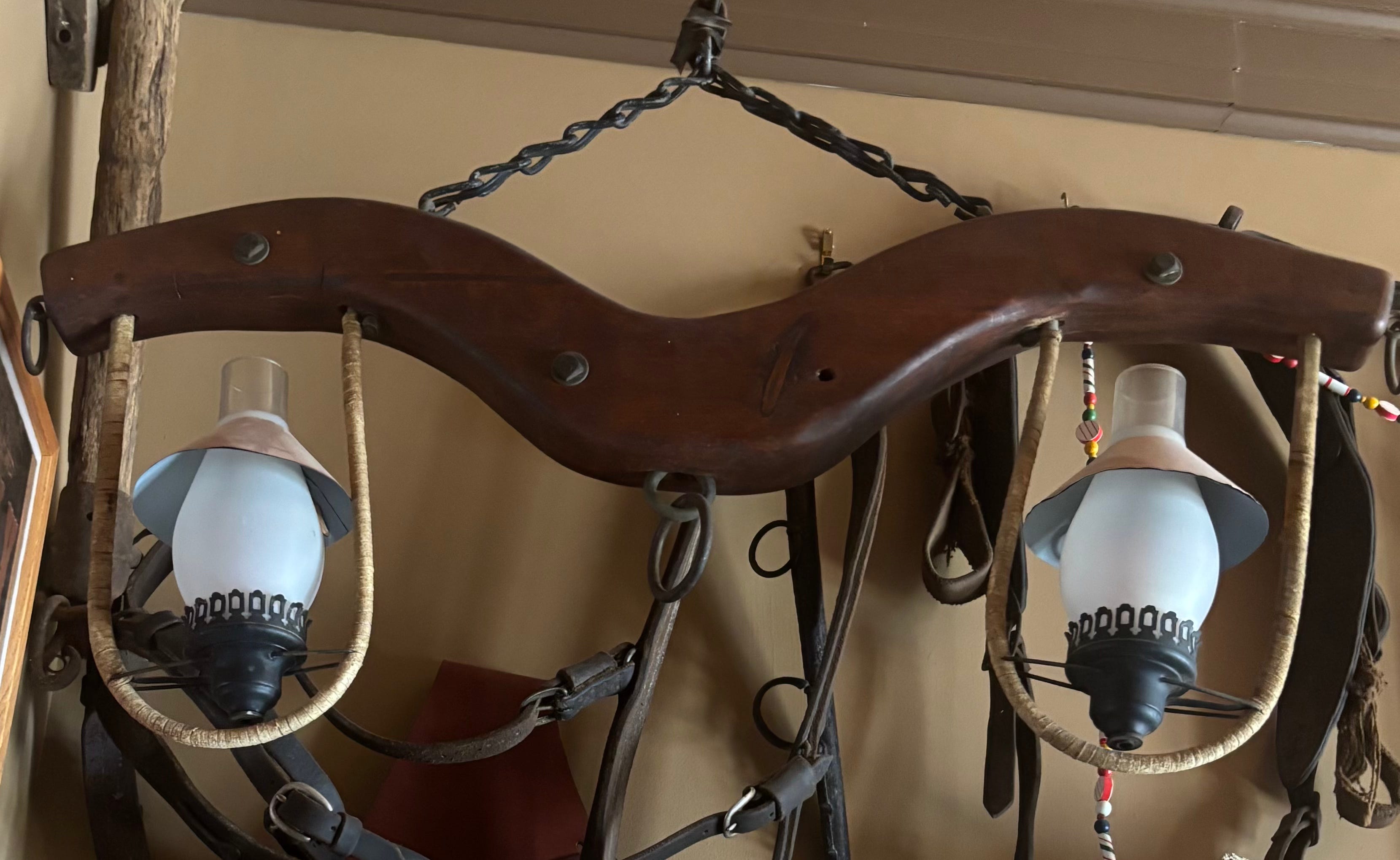
Image: Photograph of the Yoke-Lamp made by my grandfather, Bob Powell.
I love the lamp. It’s ingenious!